doPhysics.in
Profile

Mathematical Tools & Measurement

  1. 01Basic Essential Mathematics
  2. 02Vectors
  3. 03Differentiation
  4. 04Applications of Differentiation
  5. 05Integration
  6. 06Applications of Integration
  7. 07Physical Quantities and Units
  8. 08Dimensional Formula
  9. 09Dimensional Analysis and Its Applications
  10. 10Experimental Skills

Kinematics

  1. 01Motion in One Dimension
  2. 02Motion in Multiple Dimensions
  3. 03Relative Velocity
  4. 04Circular Motion Kinematics
  5. 05Circular Motion Dynamics

Dynamics

  1. 01Forces and Laws of Motion
  2. 02Laws of Motion
  3. 03Friction
  4. 04Force and Potential Energy
  5. 05Fundamentals of Force
  6. 06Newton's Laws and Free Body Diagrams
  7. 07Applications: Objects in Equilibrium
  8. 08Applications: Objects in Motion
  9. 09Constraint Relations
  10. 10Inertial and Non-Inertial Frames
  11. 11Basics of Friction
  12. 12Applications of Friction

Work, Energy, and Power

  1. 01Conservation of Mechanical Energy
  2. 02Work and the Work-Energy Theorem
  3. 03Work and Kinetic Energy Theorem
  4. 04Energy and its Conservation
Theory/Dynamics

Dynamics · Chapter 12

Applications of Friction

Applications of Friction detailed theory study guide for Physics.

12 min read · 4 topics

01

Key Concepts

Key concepts will be added here.

02

Examples

Examples will be added here.

03

Introduction to Applications of Friction

Welcome to Applications of Friction. Content to be added.

04

Friction Force - Applications

Angle of Friction

The angle of friction is the angle that the resultant of the limiting friction and the normal force makes with the normal force. It is denoted by λ\lambdaλ.

tan⁡(λ)=fs,maxN=μsNN=μs\tan(\lambda) = \frac{f_{s,max}}{N} = \frac{\mu_s N}{N} = \mu_stan(λ)=Nfs,max​​=Nμs​N​=μs​

So, the coefficient of static friction is equal to the tangent of the angle of friction.

Cone of Friction

The cone of friction is the cone generated by revolving the resultant of the normal force and the limiting friction force about the normal force. If the resultant of the applied forces is within the cone of friction, the object will remain in equilibrium.

Angle of Repose

The angle of repose is the maximum angle of an inclined plane at which a body can remain at rest, held by friction. Beyond this angle, the body will start to slide down. It is denoted by α\alphaα.

At the angle of repose, the component of gravity pulling the object down the incline is equal to the maximum static friction.

mgsin⁡(α)=fs,max=μsN=μsmgcos⁡(α)mg \sin(\alpha) = f_{s,max} = \mu_s N = \mu_s mg \cos(\alpha)mgsin(α)=fs,max​=μs​N=μs​mgcos(α)

tan⁡(α)=μs\tan(\alpha) = \mu_stan(α)=μs​

Thus, the angle of repose is equal to the angle of friction.

Animation showing inclination continuously increased until block slides.

Solving Friction Problems

Here is a general strategy for solving problems that involve friction:

  1. Draw a Free-Body Diagram (FBD): Draw a clear FBD for each object in the system. Show all forces acting on the object, including gravity, normal forces, applied forces, and friction.
  2. Choose a Coordinate System: Choose a convenient coordinate system. It is often helpful to align one axis with the direction of motion or the inclined surface.
  3. Apply Newton's Second Law: Apply Newton's Second Law (ΣF=ma\Sigma F = maΣF=ma) to each object, resolving the forces into their components along the chosen axes.
  4. Analyze the Friction Force:
    • If the object is at rest, use the condition of static equilibrium (ΣF=0\Sigma F = 0ΣF=0). The static friction force will be equal and opposite to the net applied force, up to its maximum value, fs,max=μsNf_{s,max} = \mu_s Nfs,max​=μs​N.
    • If the object is on the verge of moving, the static friction is at its maximum: fs=fs,max=μsNf_s = f_{s,max} = \mu_s Nfs​=fs,max​=μs​N.
    • If the object is moving, use the kinetic friction force, fk=μkNf_k = \mu_k Nfk​=μk​N. The direction of kinetic friction is always opposite to the direction of velocity.
  5. Solve the Equations: Solve the resulting system of equations for the unknown quantities.

Example Problem

A 10 kg block is pulled across a horizontal surface by a force of 50 N at an angle of 30° above the horizontal. If the coefficient of kinetic friction is 0.2, what is the acceleration of the block?

Solution:

  1. Draw the FBD: The forces acting on the block are gravity (mg), the normal force (N), the applied force (P). Kinetic friction (f_k).
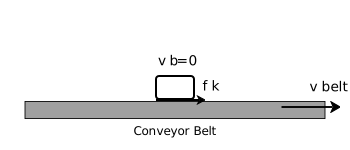
Block placed on a moving conveyor belt. Friction acts to match block's velocity with belt's velocity.

  • Choose Coordinates: Let the x-axis be horizontal and the y-axis be vertical.
  • Apply Newton's Laws:
    • Y-direction: Since there is no vertical acceleration, the net force in the y-direction is zero.

      ΣFy=N+Psin⁡(30°)−mg=0\Sigma F_y = N + P \sin(30°) - mg = 0ΣFy​=N+Psin(30°)−mg=0

      N=mg−Psin⁡(30°)=(10)(9.8)−50(0.5)=98−25=73 NN = mg - P \sin(30°) = (10)(9.8) - 50(0.5) = 98 - 25 = 73 \, \text{N}N=mg−Psin(30°)=(10)(9.8)−50(0.5)=98−25=73N

    • X-direction: The net force in the x-direction causes the acceleration.

      ΣFx=Pcos⁡(30°)−fk=ma\Sigma F_x = P \cos(30°) - f_k = maΣFx​=Pcos(30°)−fk​=ma

  • Calculate Friction: The kinetic friction is fk=μkN=(0.2)(73)=14.6 Nf_k = \mu_k N = (0.2)(73) = 14.6 \, \text{N}fk​=μk​N=(0.2)(73)=14.6N.
  • Solve for Acceleration:

    50cos⁡(30°)−14.6=10a50 \cos(30°) - 14.6 = 10a50cos(30°)−14.6=10a

    50(0.866)−14.6=10a50(0.866) - 14.6 = 10a50(0.866)−14.6=10a

    43.3−14.6=10a43.3 - 14.6 = 10a43.3−14.6=10a

    28.7=10a28.7 = 10a28.7=10a

    a=2.87 m/s2a = 2.87 \, \text{m/s}²a=2.87m/s2

  • Advantages and Disadvantages of Friction

    Friction is often called a 'necessary evil' because it has both useful and harmful effects.

    Advantages of Friction

    • Walking: Friction between our shoes and the ground allows us to walk without slipping.

    Friction is essential for walking.
    Friction is essential for walking.

  • Writing: Friction between a pen or pencil and paper is necessary for writing.
  • Braking: Brakes in vehicles use friction to slow down and stop.
  • Holding objects: Friction allows us to grip and hold objects.
  • Lighting a match: Friction between the matchstick and the striking surface generates heat to ignite the match.
  • Disadvantages of Friction

    • Wear and Tear: Friction causes moving parts of machinery to wear out over time.
    • Energy Loss: Friction opposes motion. Consequently, energy is wasted in overcoming it, usually as heat. This reduces the efficiency of machines.
    • Heat Generation: Friction produces heat, which can damage machinery or cause unwanted effects.
    • Reduces Speed: Friction slows down moving objects.

    A block is at rest on a rough inclined plane. The frictional force acting on it is...

    PreviousBasics of FrictionNextConservation of Mechanical Energy
    doPhysics
    TheoryPricingAboutPrivacy PolicyTerms and Conditions

    © 2026 doPhysics. All rights reserved.

    Engineered by Ankit Shukla